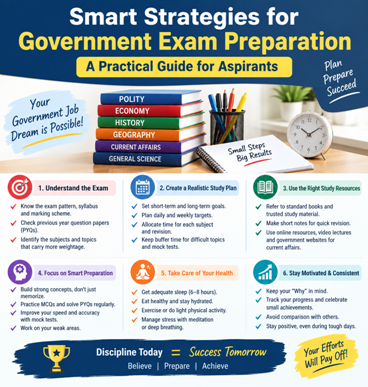
Smart Strategies for Government Exam Preparation: A Practical Guide for Aspirants
List of Contents
TogglePreparing for a government exam takes time, patience, and consistent effort. Every year, thousands of candidates apply for government jobs in India, hoping to build a stable career. Exams conducted by the UPSC, SSC, Railway Recruitment Boards, banking institutions, and state public service commissions attract candidates from different educational backgrounds.
With so many applicants competing for limited vacancies, preparing without a clear plan can become difficult. Many aspirants spend long hours studying but struggle to remember what they have learned or complete the syllabus on time.
The good news is that effective government exam preparation does not always mean studying all day. A proper study plan, regular revision, mock tests, and reliable information about exam notifications can make preparation more manageable.
Here are some practical strategies to help government job aspirants prepare with confidence.
Understand the Exam Pattern and Syllabus:
Before starting your Government Exam preparation, take time to understand the exam you want to write. Each government exam has its own syllabus, selection process, marking scheme, and difficulty level.
For example, SSC exams may include sections on quantitative aptitude, reasoning, English, and general awareness. Banking exams often focus on reasoning ability, quantitative aptitude, and English, while UPSC examinations require broader preparation across several subjects.
Read the official notification and syllabus carefully. Find out which subjects are included, how many stages the selection process has, whether negative marking applies, and how much time is available for each paper.
- Download the latest official syllabus.
- Check the examination pattern and marking scheme.
- Identify the subjects and topics that need more attention.
- Review previous years’ question papers to understand the types of questions asked.
Having a clear idea of the syllabus helps you avoid studying unnecessary topics and keeps your preparation focused on the exam requirements.

Create a Realistic Study Timetable :
A study timetable helps you organise your day and make steady progress. However, a timetable should match your daily routine rather than follow an unrealistic schedule.
If you are a college student or working professional, you may not have eight or ten hours available for preparation. You can still make progress by studying consistently for a few focused hours every day.
Divide your available time between different subjects. Give more attention to difficult topics while making sure you do not completely ignore your stronger subjects.
- Morning: Revise general knowledge or current affairs.
- . First study session: Learn a new topic in mathematics or reasoning
- Second study session: Practise English or another language section
- Evening: Solve practice questions and review mistakes.
- Before sleeping: Revise important facts or short notes.
Adjust this schedule according to your exam and personal commitments. Keep some extra time for topics that take longer than expected. A realistic timetable that you follow regularly is more useful than a perfect timetable that becomes difficult to maintain.
Focus on Understanding the Basics :
Many government exams test a candidate’s understanding of fundamental concepts. Trying to solve difficult questions without learning the basics can lead to confusion and wasted time.
Start with the fundamentals of each subject. In mathematics, revise percentages, ratios, averages, profit and loss, and basic arithmetic where relevant to your exam. For reasoning, practise common question types such as series, coding-decoding, directions, and logical relationships.
For general studies, build a basic understanding of history, geography, polity, economics, and other subjects included in your syllabus.
Use standard textbooks, reliable study materials, and beginner-friendly explanations when needed. Avoid collecting too many books or switching between different resources for the same topic.
Once you understand a concept, solve a few basic questions before moving to more difficult ones. This approach helps you build confidence and improves your ability to handle unfamiliar questions.
Practice Previous Years’ Question Papers :
Previous years’ question papers are among the most useful resources for government exam preparation. They help candidates understand the question format, identify frequently tested concepts, and assess their current level.
Try solving question papers from previous examination cycles under timed conditions. This will give you an idea of how well you manage the available time.
After completing a paper, do not focus only on your score. Review every incorrect answer and identify why you made the mistake.
- Did I misunderstand the question?
- Was my concept unclear?
- Did I make a calculation error?
- Did I spend too much time on one question?
- Was I unsure about the correct answer?
Maintain a notebook of common mistakes and revisit it regularly. Learning from these mistakes can help prevent them from happening again. Remember that previous papers are useful for understanding exam trends, but they cannot guarantee which questions will appear in the next examination.
Make Revision a Daily Habit :
Studying a topic once is rarely enough to remember it for a long time. Without revision, important facts, formulas, dates, and concepts can become difficult to recall.
Instead of waiting until the entire syllabus is complete, revise what you have studied throughout the week.
You can prepare short notes containing important formulas, definitions, historical events, constitutional provisions, vocabulary, and other facts relevant to your examination.
For general awareness and current affairs, keep your notes organised by topic or month. This makes it easier to revise information before the examination.
One simple method is to review a topic on the day you study it, revisit it a few days later, and test yourself again the following week. Adjust the intervals according to how well you remember the material.
Regular revision helps you retain information and reduces the pressure of trying to learn everything at the last minute.
Take Mock Tests and Analyse Your Performance :
Mock tests allow you to practise in an environment similar to the actual examination. They can help you improve speed, accuracy, time management, and confidence.
Start taking topic-wise tests after completing individual chapters. As your preparation improves, attempt full-length mock tests based on the latest exam pattern.
After every test, analyse your performance instead of immediately moving to the next one.
Check your accuracy, the time spent on each section, the questions you skipped, and the mistakes you made. If you consistently struggle with a particular subject, spend additional time strengthening that area.
Do not become discouraged by a low score in the beginning. Mock tests are meant to identify gaps in your preparation before the actual examination.
The goal is not simply to attempt more tests. It is to learn from each test and improve your performance gradually.

Stay Updated with Current Affairs and Official Notifications:
Current affairs play an important role in several government examinations. Depending on the exam, candidates may need to follow national events, government schemes, economic developments, awards, important appointments, and international news.
Choose a reliable newspaper or current affairs resource and follow it regularly. Prepare concise notes instead of trying to memorize every news item.
Equally important is staying informed about recruitment notifications. Missing an application deadline or misunderstanding an eligibility requirement can affect your opportunity to appear for an examination.
For accurate information for your Government Exam Preparation, check the official websites of the relevant recruitment bodies, such as UPSC, SSC, the concerned Railway Recruitment Board, or the appropriate state public service commission.
Before applying, carefully verify the following details:
- Educational qualifications and age limits.
- Application opening and closing dates
- Application fees and required documents.
- Examination dates and admit card updates.
- Official syllabus and selection process.
Websites that publish government job updates can help you discover opportunities, but always confirm important details through the official notification.
Use Online Resources Wisely :
Online learning has made government exam preparation more accessible. Candidates can find video lessons, practice questions, digital notes, previous papers, and mock tests without depending entirely on classroom coaching.
However, using too many resources can create confusion. You might spend more time searching for study materials than actually learning.
Choose a small number of dependable resources for each subject and follow them consistently. Use online videos to understand difficult concepts, practice platforms to solve questions, and official websites to verify exam-related information.
Be careful with social media posts that promise leaked papers, guaranteed selection, or unverified recruitment announcements. Such claims may be misleading or fraudulent.
A disciplined approach to online learning helps you use technology as a study tool rather than a distraction.
Maintain Your Health and Manage Exam Stress :
Government exam preparation can take several months or longer. During this period, it is natural to feel pressure, especially when results are delayed or other candidates appear to be progressing faster.
However, studying continuously without proper rest can make it harder to concentrate and remember information.
Try to maintain a regular sleep schedule, eat balanced meals, and include some physical activity in your daily routine. Take short breaks between study sessions to refresh your mind.
Avoid comparing your progress with every candidate you see on social media. People have different educational backgrounds, responsibilities, and preparation timelines.
If you miss a study session, return to your schedule the next day rather than abandoning the plan. Consistency over time is more important than following a perfect routine every single day.

Track Your Progress and Adjust Your Strategy :
A study plan should not remain unchanged throughout your preparation. Review your progress regularly to identify what is working and what needs improvement.
Maintain a simple record of the topics completed, mock test scores, revision sessions, and areas that require more practice.
For example, if your reasoning scores are improving but your mathematics accuracy remains low, adjust your timetable to give mathematics more attention.
Similarly, if you are spending too much time reading theory and not enough time solving questions, introduce more practice sessions.
Set weekly targets that are specific and achievable. Completing a few important topics properly is often more valuable than rushing through several chapters without understanding them.
Review your progress every week and make changes when necessary. This keeps your Government Exam preparation organised and helps you use your available time effectively.
Common Mistakes to Avoid During Government Exam Preparation :
Even hardworking candidates can lose valuable preparation time because of avoidable mistakes. Keep the following points in mind:
- Studying without a plan: Set clear daily and weekly targets
- Using too many books: Stick to a few reliable resources and revise them well.
- Ignoring mock tests: Practice under timed conditions to improve exam readiness
- Avoiding difficult subjects: Identify weak areas early and work on them regularly.
- Neglecting revision: Revisit important topics throughout your preparation.
- Trusting unofficial notifications: Verify recruitment details through official sources.
- Focusing only on study hours: Measure progress by understanding, accuracy, and improvement rather than time spent alone.
Avoiding these habits can make your Government Exam Preparation more focused and productive.
Conclusion :
For a government exam preparation requires a clear strategy, regular practice, and patience. There is no single method that works for every candidate, but a few habits can make a significant difference: understanding the syllabus, following a realistic timetable, practising previous years’ question papers, revising regularly, and analysing mock test performance.
It is also important to stay updated with official recruitment notifications and take care of your physical and mental well-being during preparation.
Whether you are preparing for SSC, UPSC, banking, railway recruitment, or state-level government examinations, focus on making steady progress instead of looking for shortcuts.
Start with a practical study plan, follow it consistently, and improve your strategy as you learn. With disciplined preparation and the right resources, you can approach your chosen government examination with better confidence and readiness.